- 03/06/2026
- Posted by: MOTIVATE students
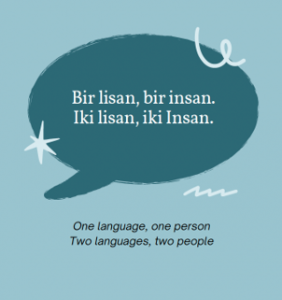
Today we are excited to share insights from our latest MOTIVATE! House Session, which took place on April 29. This session was particularly special, because we were able to welcome our guests from Akdeniz University in Antalya, Turkey for the first time. Among them was Rabia Bayındır from the Faculty of Education, accompanied by a group of twelve students. Thank you all for coming we were so gratefull to have you over. This international exchange did not just create a truly enriching and diverse learning environment for us students, but also marked an important step beyond our previously existend European collaboration.
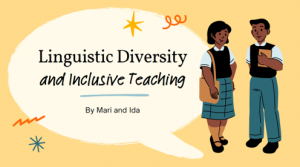
Due to the time difference, the session started earlier than usual at 17:00, which allowed us to connect simultaneously across countries. We were guided through the topic “Linguistic Diversity and Inclusive Teaching” by Mari and Ida, who introduced us to a field that we had not yet explored in depth within the MOTIVATE! program.
House Session: Language Diversity in Education
The session began with an interactive warm-up activity, where we created personal “language maps” to reflect on the languages we use in different contexts of our lives. This exercise encouraged us to think about how languages are connected to spaces, identities, and experiences. In small breakout groups, we shared our linguistic backgrounds and discussed similarities and differences, which highlighted the diversity and personal lives within our group.
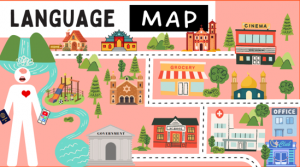
Personally I really liked the opportunity to connect with the students from Akdeniz University and the small group discussions felt surprisingly personal and engaging, even within the virtual setting. It was especially enriching to talk about why we personally chose to learn languages, what they mean to us, and how they shape our identities. An example could’ve been: „While School-Education is mostly connected with German for me, cause I grew up in a German schoolsystem; Family reminds me more of Spanish, cause this is the language we speak at home; but work f.e. since I work in an international Company, work is mostly happening in English“. This way we all actually learned a lot about each other.
Another interesting point were the different perspectives on how or which languages are valued in different countries and why. These conversations made visible how strongly language is connected to social recognition, opportunities, and personal experiences. What also surprised me was that several of the Turkish exchange students shared that they have family connections in Germany, which creats a personal connection for them to the country, the MOTIVATE! Program and the language interest.
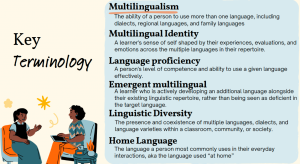
During the House Session, we were also introduced to key concepts such as multilingualism, multilingual identity, and linguistic diversity. We explored how language proficiency and home languages shape learners’ identities and educational experiences. The discussion also touched upon the idea of “prestige languages” and how certain languages are socially valued more than others, influencing opportunities and perceptions.
Another important aspect of the session focused on challenges in linguistically diverse classrooms. These included a lack of teacher training, insufficient materials, and uncertainty about how and when to integrate students’ home languages into teaching. At the same time, we discussed the benefits of multilingualism, emphasizing how inclusive practices can support learning, identity development, and participation.
To connect theory with practice, we learned about concrete approaches such as the Rucksack Project, which promotes multilingualism by involving families and integrating home languages into early education. Additionally, the MADE framework provided structured guidance for implementing multilingual pedagogies in the classroom, focusing on aspects such as learning environments, teaching materials, and language awareness. In case you’re interested in learning more about ‚real life implementation‘, here a Link to the ‚RucksackSchule-Artikel‘: https://www.berlin.de/ba-friedrichshain-kreuzberg/aktuelles/bezirksticker/2026/programm-rucksack-schule-kreuzberg-1665830.php
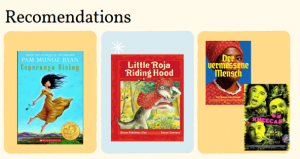
The session concluded with a collaborative exchange and some Literature Recomendations that can be helpfull for us to actively apply the concepts we had discussed and reflect on how inclusive teaching can be implemented in practice.
Overall, this House Session provided us with important insights into the complexity and significance of linguistic diversity in education. It encouraged us to question monolingual perspectives and to think more critically about inclusion in the classroom. The well prepared content and especially the little group exchanges made the session feel great and even much more than just an academic discussion. We learned how language diversity can be lived and experienced in real life, and how meaningful it is to share these perspectives with others. As future educators, developing strategies to support multilingual learners will be essential in increasingly diverse educational contexts.
A Big „Thank you“ to Mari and Ida for the thoughtful structure of the session, the critical reflections, and the highly interactive elements. Your approach made the topic both accessible and engaging, and contributed greatly to the overall learning experience.
Written by Fabienne Molela